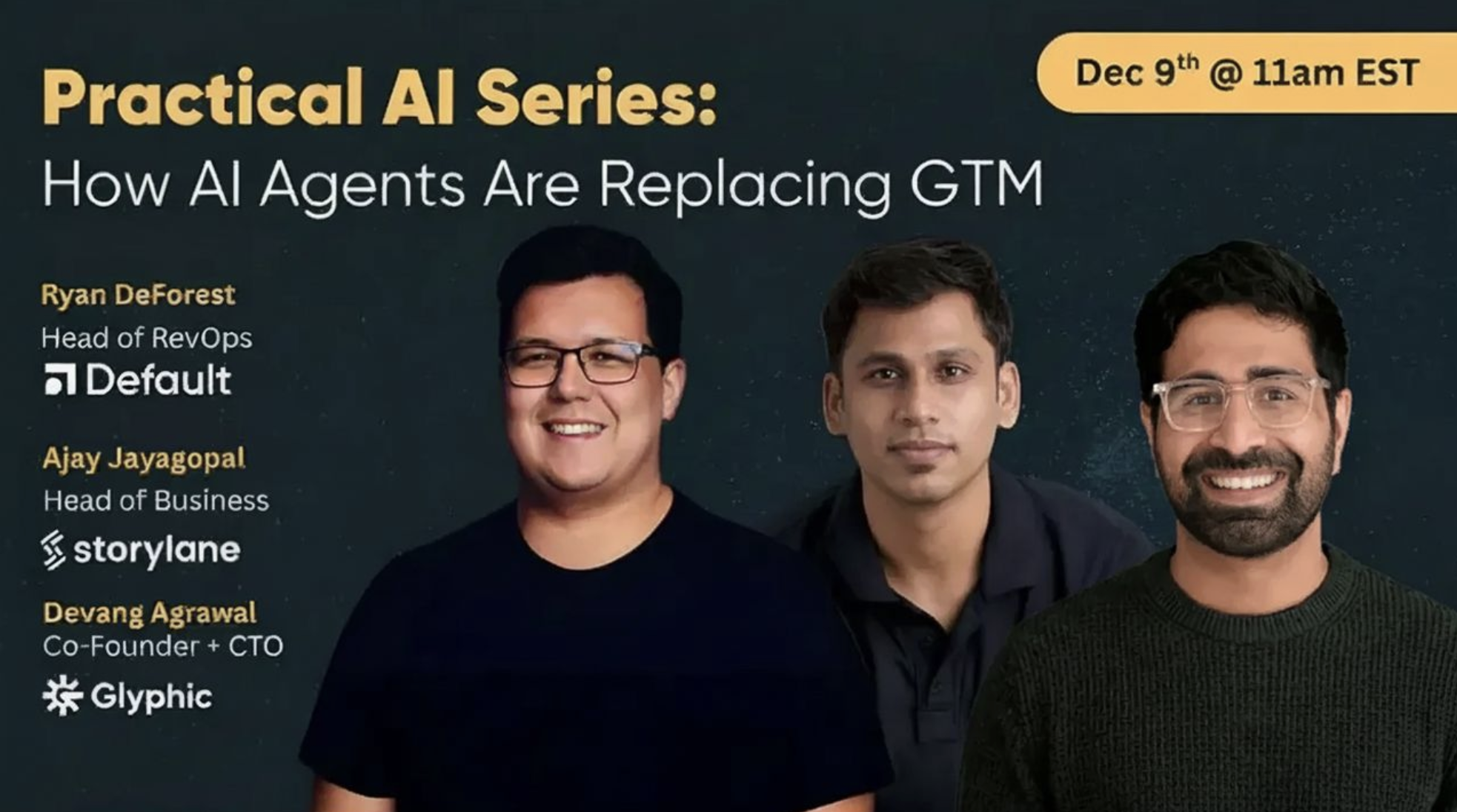
Last week, Airspeed hosted a live session with leaders from Default and Storylane on the question heading into 2026:
How do AI agents actually drive revenue for GTM teams, beyond automating tasks?
On the panel:
- Ryan DeForest, Head of RevOps at Default
- Ajay Jayagopal, former Head of Business at Storylane and co-founder of dataflo.ai
- Devang Agrawal, co-founder & CTO at Airspeed
They walked through how their teams already use agents across inbound, demos, and pipeline to move faster and win more. Missed it, or want to rewatch a part? It’s all here.
👇 Watch the full recording now
Why agents, why now
GTM teams are under pressure to do more with leaner teams: more pipeline, shorter sales cycles, and a buying experience that feels fast, personal, and consistent.
Agents have moved from “cool experiment” to the way work actually gets done.
As Devang put it during the session:
“The real value isn’t in building one-off agents anymore; it’s using agents to orchestrate your entire GTM stack so you can scale with agents, not headcount.”
That shift ran through the whole conversation.
Three takeaways for GTM leaders
1. Inbound has to move in seconds, not hours
Ryan walked through how Default uses AI to:
- Enrich and score leads inside the workflow
- Route instantly to the right owner
- Trigger calendars and follow-ups in a single flow
The pattern: speed, context, and clean routing in one motion. Teams that still treat “respond within a day” as good enough are going to lose.
2. Demos need to follow decision journeys, not feature lists
Ajay focused on the middle of the funnel, where a lot of strong products quietly lose. His points:
- Generic, one-size-fits-all demos kill momentum
- Buyers want experiences tailored to their role and internal objections
- The “demo” has to work before and after the live call: in research, in internal share-outs, in stakeholder alignment
Agent-powered personalization and interactive demos turn “this looks cool” into “this solves my problem” much faster.
3. The future is agent orchestration across your entire GTM stack
Devang shared how Airspeed customers are using AI Revenue Agents as an orchestration layer, not just a point solution:
- Outbound that learns from wins
- Agents listen to what’s actually working in closed-won deals
- Find lookalike accounts and personas
- Launch targeted outreach automatically (with human-in-the-loop where needed)
- Pipeline and forecast that don’t go dark
- Agents monitor late-stage deals for risk signals
- Surface changes before forecast calls
- Keep leaders close to reality without more meetings and manual reporting
This is where the operating model shifts. Reps review and steer what agents have done, instead of doing every task by hand.
What this means for GTM leaders
A new operating model is taking shape:
- AEs become managers of agents, approving or refining the work agents do overnight.
- BDRs run precision outbound with agents instead of broad sequences.
- RevOps shifts from building workflows to orchestrating automation that scales.
- Leadership gets cleaner, earlier visibility into forecast health.
Start with one or two high-impact agent workflows now (inbound, outbound, forecasting) and you’ll be miles ahead by mid-2026.
We run Practical AI sessions regularly, bringing GTM, RevOps, and AI leaders together to share what’s actually working in the field.
Follow Airspeed on LinkedIn to stay up to date on upcoming webinars, community events, and fresh GTM insights.