
Automatic lead qualification uses software to score and sort prospects against a set of criteria, so your team works the leads most likely to buy instead of sorting them by hand. Tools like Airspeed do it instantly, which means less wasted effort and more time on real deals.
When qualification runs automatically, you spend your resources where they convert. Sales and marketing both get more efficient because the team chases the right leads, not all of them.

What is lead qualification?
Lead qualification is how you judge whether a lead is likely to become a paying customer. The point is to separate the leads ready to talk to sales (qualified) from the ones who are not a fit (unqualified), so your team spends its time on the prospects worth pursuing.
- Qualified leads look like they might buy. They match your criteria. Focusing here is how reps use their time well and close more.
- Unqualified leads do not match the criteria and are unlikely to buy. Spotting them early saves time and effort for the leads that matter.
Automatic lead qualification sorts these leads quickly and accurately. There are other types of leads too: Marketing Qualified Lead (MQL), Sales Qualified Lead (SQL), Product Qualified Lead (PQL), and more.
Where automation fits
Automation runs a task with minimal human effort, and it makes qualification both faster and more accurate. Instead of sorting prospects by hand, you point software at the job and it checks each lead against your criteria without the slips a tired rep makes.
What automation gets you
- Efficiency: automation handles the repetitive work, so reps spend more time talking to quality leads.
- Accuracy: it cuts human error, so only leads that meet your criteria reach the sales team.
- Faster response: it checks leads quickly, so reps reach out while interest is still warm.
- Scale: as lead generation grows, automation keeps up without more headcount.
Automation does not just find who is ready to buy. It also nurtures the leads who need more information first, so no prospect slips through and each one gets the right attention.
Lead qualification frameworks and models
There are several proven methods for sorting prospects, known as qualification frameworks. Two of the most popular frameworks are BANT and CHAMP. Here is how each works and how it fits an automated system.
BANT framework
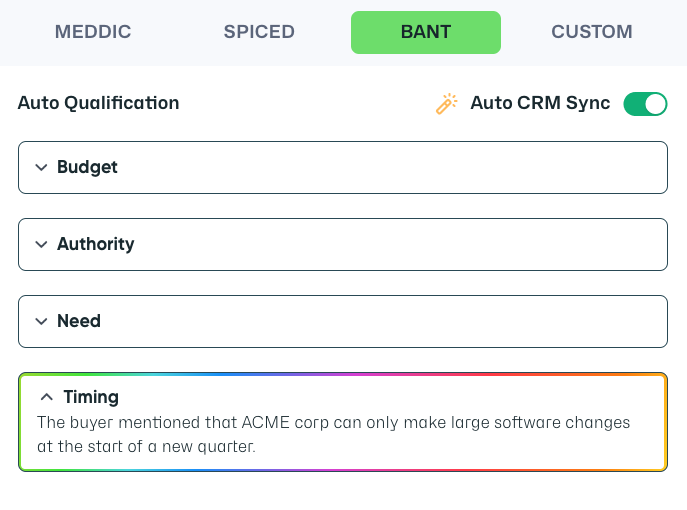
BANT stands for Budget, Authority, Need, and Timeframe. It helps your team quickly read:
- Whether a prospect has the budget to buy;
- Whether they have the authority to make the call;
- Whether they genuinely need the product;
- And whether they are ready to buy in a reasonable timeframe.
Automate the BANT criteria and your software scans the information to surface leads that meet these conditions, without a rep checking each one.
CHAMP framework
CHAMP shifts the focus and stands for Challenges, Authority, Money, and Prioritization.
- It starts with the prospect’s challenges, to see whether the product solves them;
- Then checks whether the contact can decide on a purchase;
- Next, whether the customer has the budget;
- And finally, how urgent the need is, which sets the priority.
Run BANT, CHAMP, or another framework through automation and you tighten the whole qualification process. The pipeline moves faster, and your team’s effort lands on the leads with the highest chance of converting.
The parts of an automated qualification system
Whatever your size, these are the pieces that decide which leads are worth your team’s time.
Lead scoring
Lead scoring ranks prospects by how likely they are to buy. It awards points for actions like visiting your site or opening emails, and weighs details like location or job title. That ranking tells you who to talk to first.
CRM integration
CRM stands for Customer Relationship Management: the software that holds every detail about your leads in one place. Wired into your automated system, it keeps the sales team working from the latest information on every lead and tracks who is moving toward a purchase.
Marketing automation tools
These tools run routine jobs on their own, like social posts and email sends. They keep prospects engaged by sending the right message at the right time. When a lead visits a key page, the tool can fire off more information automatically, so the experience feels personal.
Lead scoring, CRM integration, and marketing automation together make the sales process smoother and sharper, so you are always working high-quality leads.
Putting automated qualification into your process
Here is how to start, so your team spends its time on the leads most likely to convert.
- Define your scoring criteria: decide what makes a good lead for your business. Weigh things like location, how they interact with your site, and the actions that signal buying intent. Assign points to rank the leads.
- Pick the right tools: choose automation that fits your goals and works with your CRM. You want tools that score leads, track behavior, and nurture prospects until they are ready to buy.
- Integrate with your CRM: make sure your tools sync cleanly with the CRM, so the sales team always has the latest read on each lead.
- Set up nurturing campaigns: build automated emails and social messages keyed to a lead’s score and interests. Tailor the content to their pain points so it moves them toward a decision.
- Train your team: show reps how the system works and what the scores mean. Teach them to follow up fast on promising leads and adjust their approach to each lead’s level of interest.
- Monitor and adjust: watch performance. When something underperforms, dig into conversion rates, lead quality, and cycle length to find what to fix.
These steps smooth out the whole process and help you close.
Best practices
A few habits get the most out of automated qualification. Follow these to keep your approach sharp.
-
Keep your data clean: make sure contact details and customer data are correct and current.
-
Refresh your scoring: revisit how you score leads and adjust as needed. What counts as a “good” lead shifts as your business and market shift.
-
Nurture deliberately: run campaigns that keep prospects engaged at every stage, with content matched to what each lead cares about.
-
Monitor performance: track the metrics that matter, like conversion rate, lead quality, and time to close.
-
Test and experiment: try new scoring rules and new messages. Testing shows you what actually works.
Stay on these and your automated qualification keeps earning its place.
Challenges and how to handle them

Challenge 1:
- Leaning too hard on automation: automation does a lot, but it misses things a person would catch.
- Solution: have someone on your team review the system’s work, so you get fast automation and human judgment together.
Challenge 2:
- Letting data go stale: automation only works on correct, current data, and keeping it clean is real work.
- Solution: set a schedule to check your data, and use tools that help keep it accurate without much effort.
Challenge 3:
- Falling out of date: what works now may not in a few months, because the market and your customers keep moving.
- Solution: watch the trends and update your system when they shift.
Challenge 4:
- New tools to learn: every new tool means the team has to learn it, and unused tools do not help.
- Solution: keep training current so your team always knows how to use the technology.
Handle these with clear solutions and your automated qualification system keeps working.
Where automated qualification is headed
The space is moving fast. A few technologies, including AI and chatbots, are set to shape what qualification looks like next.
Emerging trends
- Artificial intelligence (AI): AI reads huge volumes of data to spot the best leads, so you focus on the people most likely to buy.
- Chatbots: chatbots talk to prospects around the clock, gather information, answer questions, and guide early decisions while collecting useful data.
- Predictive analytics: this reads past data to forecast what is likely next, helping you see which leads could convert and saving you time.
- Sharper personalization: as the technology improves, conversations with leads (like follow-ups) feel more personal, which keeps prospects engaged.
Where it is going
AI, chatbots, and predictive analytics are set to make finding and reaching prospects more efficient and more personal.
- AI sharpens qualification and saves time.
- Future tools integrate with the rest of your sales stack for better insight.
- Chatbots improve early interactions and build relationships.
- Teams put more weight on data security as they collect more.
As these technologies mature, the businesses that adopt them will find and win more customers.
Summary
Knowing your customers and how they decide is what drives growth. Run automated systems well and you make sales and marketing simpler while making sharper calls about where to invest.
Automated systems help you find the right customers faster, and as AI and chatbots improve, that only gets easier.
Ready for a tool that qualifies your leads for you? Book a demo to see how Airspeed can help.